 |
| On the "island" near the Lower Rhine -- once a front line fiercely defended by the 506th Parachute Infantry Regiment, |
Friday, September 09, 2016
Safely grazing the nether lands

Men, your relief is here. Now Zip, Fix Bayonets, Go!
 |
| Just beyond the positions our men have briefly taken is a ditch, which gave Easy Company cover to prepare. A mortar team was left here, eventually called in to play. The men, above, will perform an about face to begin their simulated charge. |
Our study group is composed of mostly senior gentlemen, so by the time the patrol had walked to its starting point, special preparations for their simulated bayonet charge were necessary. Once everyone had been securely zipped, the order to fix bayonets was given. The run was longer than most expected it to be. The distance required stamina, stealth and courage, assets that Easy Company held in great measure.
Today's volunteers, not so much.
 |
| The Germans were settled in behind the tree line in the distance, beyond a roadway that leads to the river. The Germans were waiting for more troops to be ferried across the river and were caught off guard. The dike, with a road on top of it, is at the right just beyond our hard-charging patrol leader, Bubba. The charge was made parallel to the dike, a detail not so clear in "The Band of Brothers" portrayal. We watched the episode in the bus before our arrival here. |
Thursday, September 08, 2016
Church Bell Tower view of Hell's Highway
 |
| That's Hell's Highway, with its original brick surface below, passing in front of the cafe where we lunched today. Lt. Winters glassed the horizon and saw enemy action in the next town from this position. |
 |
| Peter and the Bell, about to give the clapper a toss. |
After signing waivers, our study group got permission to ascend the 60 meters to the observation point. Seven rickety century-old ladders later, we found ourselves at the top with Sextant Peter R. (sp).
When Lt. Winters used this as an observation post in 1944, a sniper spotted him and fired a round that glanced off the church bell. To add authenticity to our experience, the plucky Dutchman gave the huge bell a clang or two, rattling our ear drums and shaking our bones -- and possibly confusing the town's population about what time it was..
Then we ventured out on the catwalks around the massive dome over the altar, and looked down at the more squeamish in our party. It was a day for adventure and adrenalin. And we forgot to light a candle before we went up.
=============
Photo left: We had lunch in the cafe on Hell's Highway. Dutch bikers whizzed past and an
old fellow on a battery-powered 3-wheeler stopped to reminisce with our party about being forced to learn German during the five years of occupation. It was a tense time, he said. We waited for our appointment with the church deacon from across the street, then made our
way through this historic building, literally
from bottom to top.
 |
Then we ventured out on the catwalks around the massive dome over the altar, and looked down at the more squeamish in our party. It was a day for adventure and adrenalin. And we forgot to light a candle before we went up.
=============
Photo left: We had lunch in the cafe on Hell's Highway. Dutch bikers whizzed past and an
old fellow on a battery-powered 3-wheeler stopped to reminisce with our party about being forced to learn German during the five years of occupation. It was a tense time, he said. We waited for our appointment with the church deacon from across the street, then made our
way through this historic building, literally
from bottom to top.
 |
| Look closely and you'll see two of our cadre on the maintenance catwalk along the dome over the altar. Shaky. Ridiculous. |
Reporting from Uden, in a cathedral on Hell's Highway
 |
| He also knows Dixie. Fortunately. . . |
 |
| Some of us climbed to the top for a look out. |
Bubba McHan, -- (no kidding, that's what the name tag says), a good ol' boy from Alabama and a devout Baptist who enjoys tweaking Yankee travelmates with an occasional "The South SHALL Rise Again!" in a lazy drawl, -- stepped forward. Bubba calmly selected Pachelbel' s Canon in D and stunned his audience with a powerful rendition that filled the massive sacristy and left this Yankee open-mouthed.
A classically trained organist? Nope. He says he just copied his sister. He actually plays the guitar and a variety of other instruments, once for a Beatles Tribute band. He's got a family now and sells medical supplies. This trip to the choir loft was all part of our World War II study mission, understand. Easy Company of the 506th Parachute Infantry Regiment set up a defense in this area and used the bell tower to spot the enemy. We were on the way to the top to see where Lt. Dick Winters looked out to see the enemy and was sent skittering down when a sniper's bullet clanged the bell. Nothing ever written about Lt. Winters playing the organ. More on him later.
Wednesday, September 07, 2016
Ike's view on war from here
 |
| These two fellow travelers were asked to sit here while our leader told this story: |
Omaha Beach defenses
 |
| This gun emplacement inflicted the most harm. Aimed at right angles to the ocean it raked the beach with murderous fire. It was finally taken out by Rangers coming from the right, as depicted by Tom Hanks in the opening scenes of Saving Private Ryan. Back in the day, as now, there was a casino and numerous holiday houses on the shoreline. |
 |
| Entrance to Pvt. Goeckel's living quarters. |
Our guide, Ron Drez, has interviewed as many as 3000 veterans during his career as a writer/historian.. Among them were Germans, notably a Pvt. Franz Gockel. Drez got to know Gockel and stood with him at his deadly Omaha Beach position on more than one occasion. This morning he read from Gockel's personal account of the courageous Americans rushing toward him for hours on the morning of D-Day, as he cut them down with his Czechoslovakian-made machine gun, aiming at the troops as they disembarked their landing craft. He had trained diligently for this duty and defended Strong Point 62 until finally, at about 11 a.m., the Americans chased him out, killing most everyone else. His 150 comrades, in their hardened positions, had created 90 percent of the casualties of the day.
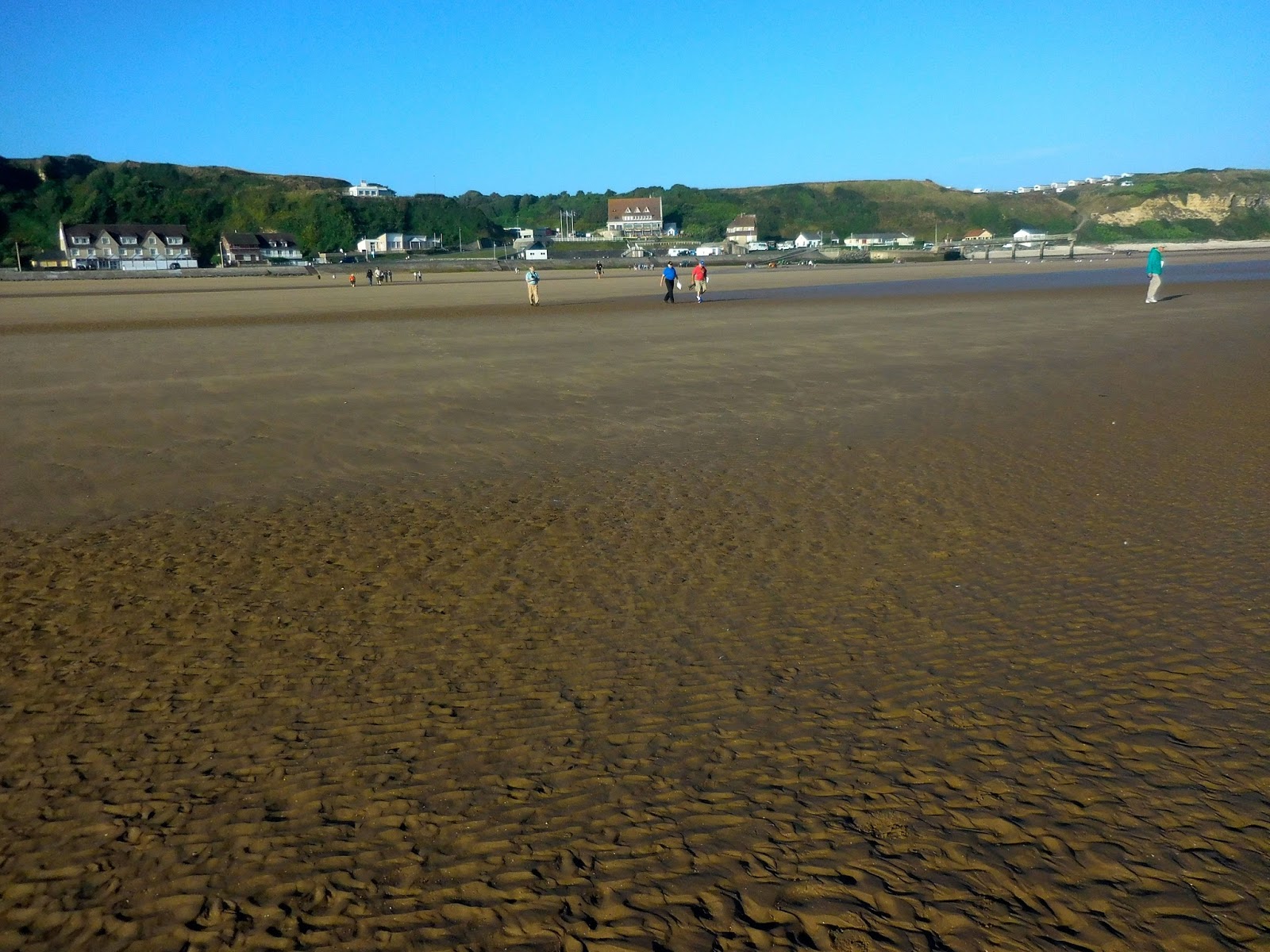 |
| Dog Red. Visitors are amazed at the immenseness of the beach at low tide when the assault troops arrived. Low tide avoided the obstacles placed by Rommel, but left a great distance for men under fire. The tide moves back in quickly, adding to the difficulties.. The largest building marks the exit to the high ground with the gun emplacement in the cliffs to the right. The photographer is well within its range. The objective was to clear the draw to allow logistics to move forward. It was dearly paid for. |
A Beautiful Morning, a Memorable Day
 |
| It's not always like this, our guide warned, as we enjoyed another day of open skies and light breezes, highs of 79. Looking out from Sacred Ground, the darker blue of the ocean meets the sky behind this perfectly-manicured treasury of American youth. |
At the American Cemetery above Omaha Beach

 |
| French tourists with guide under the map of the European Theatre of Operations. |
It was not necessary to understand her melodic tongue as she gestured and explained to her rapt audience, clearly touching them with her presentation. The unnoticed American among these French tourists was moved as well, but perhaps in a different way.
 |
| Youth Rising From The Waves Central Sculpture in American Cemetery. |
Remembering Cousin Ed

Jeff told us what he knew of the lieutenant, including how it was that his name is spelled differently from others in the clan.
Subscribe to:
Posts (Atom)